Cooperative Program Promotion, Stewardship Education, and the
Southern Baptist Convention An Historical Review
On February 22, 2010, the Great Commission Task Force issued a “Progress Report” on ways it hopes
to assist Southern Baptists to “work more faithfully and effectively together in serving Christ through the Great Commission.” The
32-page report contains a brief sermon outline, eight core values, and six principal “components.” This brief essay will evaluate
its Component #4 in light of the 85-year history of promotion of the Cooperative Program of the Southern Baptist Convention.
[Read More]
Video of Great Commission
Resurgence Task Force Progress Report
Great Commission Resurgence Task Force Progress Report as delivered by Dr. Ronnie W. Floyd at the SBC
Executive meeting, February 22, 2010. [Watch Video]
Great
Commission Resurgence
In late April, President Johnny Hunt issued a call to Southern
Baptists for a “Great Commission Resurgence,” with an accompanying
ten-point “Great Commission Resurgence Declaration.” This
Declaration has generated widespread interest and conversation among
Southern Baptists. The links and articles contained in this collection
are designed to assist Southern Baptists by posting the Declaration
in its various revisions and directing the reader to a sampling of
published denominational perspectives on this important and timely
subject. [Read
More]
MY
HOPE FOR OUR CONVENTION
My hope for our Convention is simple. It runs upon one premise.
It rides upon one purpose. It rests upon one person. My hope
is built on nothing less than Jesus’ blood and righteousness.
[Read
More]
Stand
For Marriage
Most of you have seen ABC TV's Extreme Makeover: Home Edition
where they tear down a house and rebuild it. Unfortunately,
there has been another Extreme Makeover happening to the American
home. Some are trying to tear down traditional marriage and
redefine it. In fact, we are only one Supreme Court decision
away from legalizing same-sex "marriage" all across
America. How should Christians respond?
[Read
More]
Final
Report of Ad Hoc Cooperative Program Committee
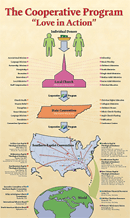
Southern Baptists have always been a missional people. From the inception
of the Southern Baptist Convention in 1845 we have always rallied around
the command of Christ to carry the Gospel to the entire world. At the
heart of our local churches, and of all organizations and agencies
beyond the local church, is the desire to share the Good News of the
Gospel of Jesus Christ. The Cooperative Program was implemented to
give each Southern Baptist a way to be a part of reaching the world
for Christ through their local church. Sadly, we too often have allowed
our focus to become ingrown and diverted from our evangelistic responsibility.
Most of the strategies and initiatives in this report focus on telling
the story of what we are currently doing through the Cooperative Program,
but we must not fall into the trap of thinking we can reposition the
Cooperative Program in the hearts of Southern Baptists by focusing
only on what we are accomplishing. [Read
More]
Final Report of Ad Hoc Cooperative
Program Committee (Appendices)
Appendix A, B and C for Final Report of Ad Hoc Cooperative
Program Committee
[Read More]
Fourth
Report of the SBC Funding Study Committee
The SBC Funding Study
Committee (FSC) is an ad hoc committee of the Executive Committee,
having been charged by action of the full Executive Committee
in February of 2002 with the task of studying Southern Baptist
Convention funding issues. The study was begun against a backdrop
of recognition that the SBC seminaries faced financial challenges,
although funding issues relating to all our entities are within
the committee’s
scope of discussion and review. [Read
More]
|

 About
the SBC
About
the SBC 





 "There
should be an 'Abstract of Principles', or careful statement of theological
belief, which every professor in such an institution must sign when
inaugurated, so as to guard against the rise of erroneous and injurious
instruction in such a seat of sacred learning."
"There
should be an 'Abstract of Principles', or careful statement of theological
belief, which every professor in such an institution must sign when
inaugurated, so as to guard against the rise of erroneous and injurious
instruction in such a seat of sacred learning."